
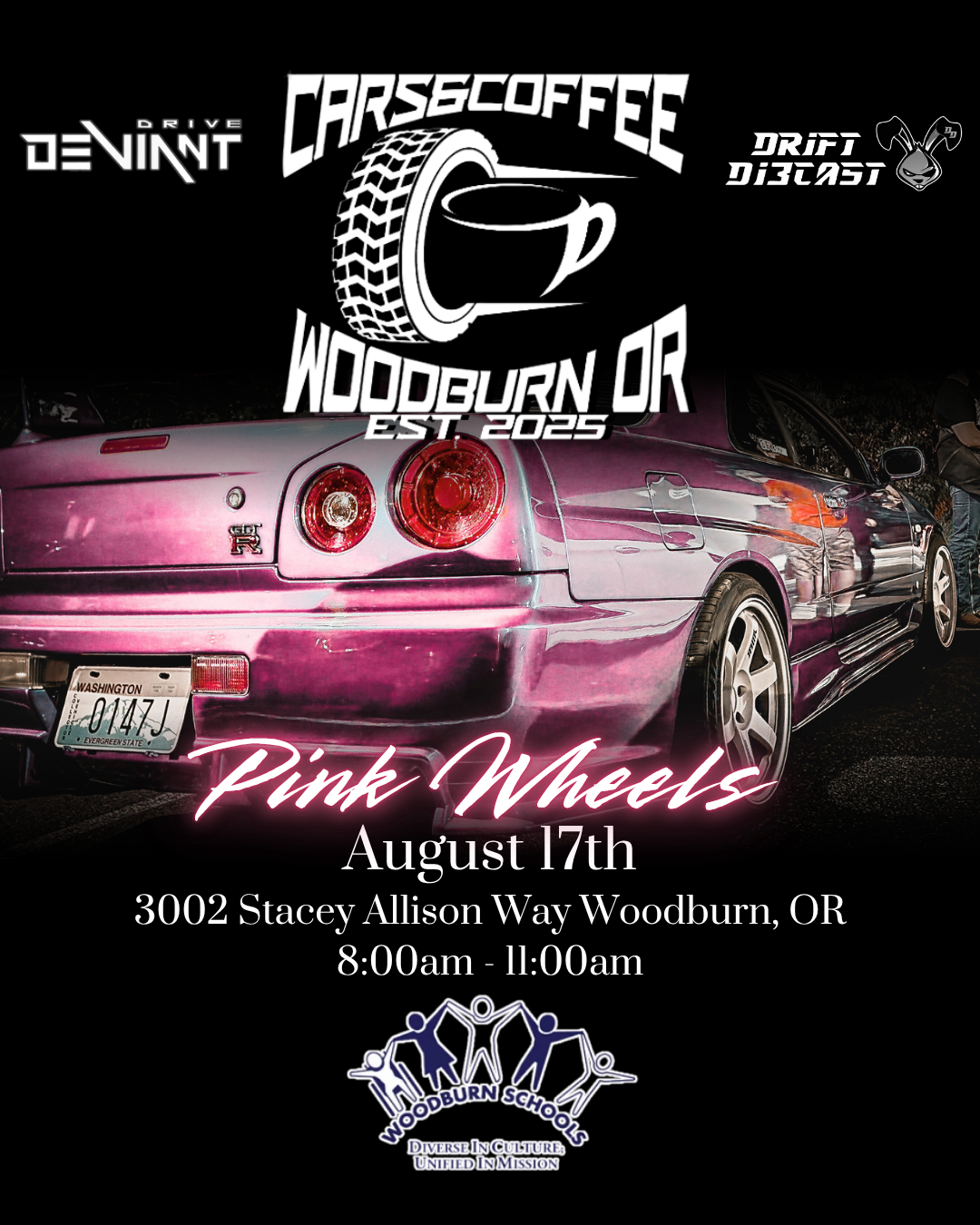
Woodburn Cars and Coffee’s Tribute to Women in Automotive
When people think of the automotive industry, they often picture men. From founders like Ford, Ferrari, and Honda, to motorsports heroes and media icons, the spotlight has too often focused on just one side of the garage.
But the road we all drive on was paved by women—engineers, racers, inventors, designers, and enthusiasts—who shaped automotive history and culture in ways both visible and unseen.
Pink Wheels isn’t just about showing up in a car with pink accents. It’s our annual theme day dedicated to recognizing the women who built, tuned, raced, engineered, photographed, and led the way for automotive culture as we know it. And it’s about encouraging the next generation of women to take the wheel and keep driving forward.
Expect to see:
- Vehicles built and driven by women
- Photographers, tuners, and engineers
- Stories, vendors, and creators celebrating legacy and innovation
- Community-driven support for inclusion in the car scene
Inventors & Engineers
Women have revolutionized the way we drive. In fact, without them, many features we now take for granted wouldn’t exist:
Margaret Wilcox (1838) created the earliest version of a car heater, redirecting heat from the engine into the cabin. Her design became the foundation for climate control systems still used today.
Mary Anderson (1866–1953) invented the first windshield wiper in 1903, while Charlotte Bridgwood mechanized the concept years later. Though neither saw commercial success in their lifetimes, Cadillac adopted the feature in 1920—after Charlotte’s patent expired.
Florence Lawrence (1886), a silent film star, invented early versions of the turn signal and brake light, including mechanical signs that indicated the driver’s intention to turn or stop. Though she chose not to patent her designs—believing they should benefit everyone—her innovations helped shape driver communication as we know it.
Gladys Mae West, a mathematician and project manager for the U.S. Navy, led satellite research that laid the foundation for GPS navigation. Her work, combined with Hedy Lamarr’s development of secure radio communications during WWII, underpins everything from navigation systems to modern wireless technology.
Designers & Visionaries
Helene Rother, a Holocaust refugee and pioneering designer, joined GM in the 1940s and introduced vibrant, stylish interiors that helped the brand stand out. Before her work, car interiors were designed mostly for durability and muted tones. Her influence led to a shift in automotive design philosophy and earned her a place in the Automotive Hall of Fame in 2020.
In the 1950s, GM’s Damsels of Design—an all-women design team—brought forward innovative features like retractable seatbelts, childproof doors, and illuminated mirrors. Their work blended functionality with aesthetics, making cars not just safer, but smarter.
Drivers & Trailblazers
Bertha Benz, wife and business partner of Carl Benz, is often overlooked in automotive history. In 1888, she undertook the first long-distance car trip—over 60 miles—proving the reliability of the “horseless carriage.” Along the way, she troubleshooted mechanical failures and even invented the first brake pads. Without her bold journey, cars might never have reached the public stage.
Alice Ramsey was the first woman to drive coast to coast across the United States in 1909. She later founded the Women’s Motoring Club and became the first woman inducted into the Automotive Hall of Fame in 2000.
Janet Guthrie, a physicist and aerospace engineer turned race car driver, was the first woman to qualify for both the Daytona 500 and Indianapolis 500 in 1977—long before Danica Patrick hit the scene.
Denise McCluggage, journalist and race car driver, co-founded AutoWeek and remained a key figure in motorsports journalism until her passing in 2015.
Pioneers & Firsts You May Not Know
- Anne Rainsford French Bush became the first woman licensed to drive in the U.S., using a steam engineer’s license to operate a four-wheeled vehicle in 1900.
- June McCarroll, a nurse and physician, proposed the idea of painting dividing lines on roads in 1917—an idea that shaped modern traffic flow.
- Women throughout history have been mechanics, engineers, and builders, even if they didn’t always receive credit.
Why Pink Wheels Matters
This event isn’t about novelty or aesthetic—it’s about visibility, community, and respect.
By sharing these stories, seeing the vehicles built and driven by women, and connecting in person, we’re helping shift the narrative of who belongs in car culture.
So bring your builds. Bring your friends. Bring your support.
Let’s celebrate the women who drove us here—and the ones driving us forward.
Join us for Pink Wheels
Sunday, 8–11 a.m. | 📍 Woodburn Cars and Coffee
All vehicles welcome—women-driven and women-supporting encouraged.
Discover more from Woodburn Cars and Coffee
Subscribe to get the latest posts sent to your email.
 Woodburn Cars and Coffee